Two members of the New People's Army's (NPA) were nabbed while one escaped pursuing authorities in Sorsogon province, radio dzMM reported Tuesday morning.
Tuesday, October 16, 2007


Thursday, August 23, 2007
Young inventor markets cost-saving tie wire
 Catanduanes Tribune
The Philippines’ youngest inventor, 22-year old Dexter Teope of Virac, holds the patent for a cost-saving construction material that he hopes would become as indispensable as steel bars.
BLOOD OR MONEY?
BLOOD OR MONEY?
By Jason B. Neola
NAGA CITY – Traffic violators may soon be allowed to shed blood instead of money to settle penalty for their misdeed.
Wednesday, August 1, 2007
MT. BULUSAN ERUPTION
MT. BULUSAN ERUPTION
Bulusan, Sorsogon, PHILIPPINES
July 31, 2007
around 9:30 a.m.
Photo courtesy of Agap Bulusan
Bulusan, Sorsogon, PHILIPPINES
July 31, 2007
around 9:30 a.m.
Photo courtesy of Agap Bulusan


Wednesday, July 25, 2007
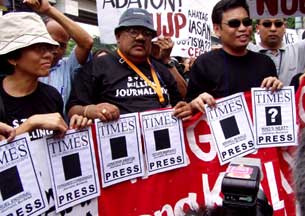
NUJP condemns shooting of Bacolod station manager
The National Union of Journalists of the Philippines (NUJP) condemns the attempt on the life of RGMA-Bacolod station manager and NUJP member Ferdinand 'Bambi' Yngson in Sagay City on Wednesday morning, July 25.
We urge authorities to get to the bottom of this case and speedily prosecute the arrested suspect and, if any, all others who may be involved in the attack on Yngson instead of dismissing it, as Sagay Philippine National Police chief William Senoron initially did, as the offshoot of personal animosity.
The suspect, Romeo Corbo, is a deputized agent of the Land Transportation Office in Sagay. Yngson's wife said before the attack, he had been commenting on alleged corruption in that office.
Again, we urge Pres Gloria Macaoagal-Arroyo to issue a categorical order to end all attacks on journalists and to get the perpetrators whoever they may be.
Only this will signal that her administration pays more than lip service to press freedom.
The bloodshed has gone on long enough!
Reference:
Jose Torres Jr., NUJP chair
July 25, 2007
We urge authorities to get to the bottom of this case and speedily prosecute the arrested suspect and, if any, all others who may be involved in the attack on Yngson instead of dismissing it, as Sagay Philippine National Police chief William Senoron initially did, as the offshoot of personal animosity.
The suspect, Romeo Corbo, is a deputized agent of the Land Transportation Office in Sagay. Yngson's wife said before the attack, he had been commenting on alleged corruption in that office.
Again, we urge Pres Gloria Macaoagal-Arroyo to issue a categorical order to end all attacks on journalists and to get the perpetrators whoever they may be.
Only this will signal that her administration pays more than lip service to press freedom.
The bloodshed has gone on long enough!
Reference:
Jose Torres Jr., NUJP chair
July 25, 2007

ARROYO’S STATE OF THE NATION 2007: A LEGACY OF ECONOMIC DECAY
In the face of its glaring failures, the Arroyo government continues to pursue the very same bankrupt economi c p olicies that caused these in the first place
By Sonny Africa
IBON Features– Undoubtedly, President Gloria Macapagal-Arroyo will use her State of the Nation Address (SONA) to hype her achievements. Arroyo would likely claim that her greatest achievement and her legacy is to set the Philippines well along the road to progress and prosperity. To buttress her claims she will certainly roll out the familiar rosy economic indicators that she has consistently used to try and silence her critics: the fastest quarterly growth rate in nearly two decades, stock market indices soaring to all time highs, record international reserves, the “strengthening” of the peso and steady increases in foreign investment.
However, these claims would not hold up to even the most cursory scrutiny. The scores of homeless people living on the streets and sidewalks of Manila testify to widespread poverty and joblessness despite Malacañang’s claims that poverty has decreased. The more than 3,000 Filipinos who leave the country every day to seek work abroad belie the government’s claim that it has generated more than 800,000 jobs a year since it came into office in 2001.
Yet, even in the face of its glaring failures, the Arroyo government continues to pursue the very same bankrupt economi c p olicies that caused these in the first place. In fact, it promises to pursue these policies even more aggressively and apply them to more areas of the economy.
Behind ‘Economic Growth’
One of the key economic indicators that the Arroyo government undoubtedly will be hyping is the continuous economic growth it has experienced. According to Palace Secretary Ricardo Saludo, the country has enjoyed twenty-five consecutive quarters of Gross Domestic Product (GDP) growth, with GDP hitting 6.9% in the first quarter of 2007, supposedly the highest in seventeen years.
But the GDP merely tracks the continued erosion of the country’s productive sectors. The share of the manufacturing sector has been steadily falling, from 25.7% of total domestic output in 1980 to 23% last year. Over the same period, agriculture fell from 25% of GDP to 14 percent.
Even if the economic growth could be taken at face value, it remains meaningless to the millions of poor Filipinos for whom its benefits have not “trickled down”. IBON estimates that some 65 million Filipinos or around 80% of the total population struggle to survive on the equivalent of P96 or less per day. This is substantially larger than the Arroyo government’s official poverty incidence figure of 24 million Filipinos.
Increased growth has also not reduced the gross income inequalities that continue to haunt the country. In 2000, the poorest 30% of families (some 3.8 million) accounted for almost 8% of total family income, while the richest 10% (1.3 million families) accounted for 38.4 percent. By 2003, inequality had barely softened, with the poorest 30% (now nearly five million families) accounting for 8.5% while the richest 10% (1.6 million families) accounted for 36.3 percent.
Meanwhile, the richest Filipinos continued to get richer. The wealth of the country’s three richest individuals/ families (Henry Sy, Lucio Tan and Jaime Zobel de Ayala and family) grew in real terms from P177.4 billion in 2001 to P261.5 billion last year.
Speculation
The Arroyo government also continues to hype the peso’s all time highs and the booming stock market. But when looked at in an overall regional context, the seven-year high of the peso and the all-time high of the stock exchange are not even particularly impressive. They merely reflect an overall trend of appreciating currencies and exuberant stock markets.
A look at the trend from 2001 shows that Asian currencies, in general, have been appreciating against the US dollar especially since the middle of 2006. The US economy is heavily weighed down by its historic budget and trade deficits as well as by the wars it is unable to win in Afghanistan and Iraq . It is also widely expected to experience an economic slowdown this year.
Asia has also been receiving markedly higher inflows of speculative investment, many of which are going to the region’s stock markets, with the trend again being especially marked since the middle of last year. During the first quarter of the year, some US$2.8 billion or 78% of gross foreign portfolio inflows into the country went to the Philippine Stock Exchange. These inflows were equivalent to nearly half of gross inflows in the whole of 2006 and two-thirds of gross inflows in 2005.
The Philippines is also one of Southeast Asia ’s laggards in terms of economi c p erformance. Philippine economic growth of 5.3% last year was the third worst in Southeast Asia and even less than the ASEAN average of 5.8 percent. The country has the worst unemployment and is the fifth poorest country in terms of GDP per capita and national poverty rates. Although comparisons of this sort are problematic because of differing methodologies and measures, it should at least serve as a wake-up call for the administration.
Fiscal Hype
Another achievement that would surely be hyped in the SONA is how Arroyo succeeded in arresting the country’s fiscal crisis through “reforms” such as the implementation of the reformed value-added tax (RVAT). But the country remains vulnerable to another financial crisis, which could explode at any time.
The budget deficit has indeed gone down from the historic high it reached it 2002 when it peaked at 5.4% of GDP. Last year it was at 1.1% of GDP. But the deficit was addressed not through improved revenues or dealing with runaway debt service payments; instead, government cut spending on vital social services such as education, heath, and housing, whose combined share in the national budget fell to 15.6% in 2007 to 19.7% in 2001.
Meanwhile, the Arroyo administration is making the most debt payments of any administration in the country’s history. Foreign and domestic debt ate up a historic 87.3% of revenues and 14% of GDP in 2006. Total debt service last year on foreign and domestic debt was a colossal P854.4 billion in 2006. And public debt continues to increase, hitting P3.9 trillion as of March 2007. National government debt was 65% of GDP in 2006.
Although the RVAT netted P76.9 billion in 2006 and P18.7 billion in the first quarter of 2007, it was not enough to make up for revenue losses from trade liberalization, corporate tax evasion and corruption. The government’s tariff reduction program has resulted in import duties as a share of total revenues falling to 19% in 2006 from 36% in 1993.
Meanwhile, corporate tax evasion may cost the government some P54 billion in lost revenues annually (according to a 1998-2002 survey by the National Tax Research Center ) and some P146 billion may have been lost to corruption in the 2007 national budget (based on the 13% estimate of the 2001 budget by the United Nations). This means that as much as P200 billion may be lost this year due to corruption and tax evasion.
In fact, government recently reported that its half-year deficit had already reached P41 billion or 65% of the year-end target of P63 billion. Its only hope now of achieving its deficit target is the privatization of some of its remaining assets, such as its stakes in San Miguel Corp. and the Manila Electric Co. (Meralco), which could fetch as much as P105 billion. But this represents a one-time boost in revenues. Thus, higher taxes on the scale of the RVAT are likely inevitable despite government denials.
Unsound fundamentals
The Philippines ’ weak productive sectors are ultimately what underpin its financial vulnerability. Its declining agriculture and manufacturing sectors result in chronic trade deficits because the country is dependent on imported inputs and finished products, while having a limited capacity to export genuinely Philippine-made goods. This in turn increases the dependence on foreign sources of financing and capital. The local economy thus becomes unduly sensitive to the fluctuations of global markets.
The country’s problems are essentially due to liberalization policies enacted under an economic globalization framework. These policies have eroded incomes and destroyed livelihoods, undermined domesti c p roductive sectors and created the conditions for financial crisis. Trade liberalization destroys local agriculture and manufacturing while reducing tariff revenues. Liberal investment regimes have given generous incentives to foreign corporations while reducing the benefits to the domestic economy to nothing.
Pres. Arroyo, a staunch believer in so-called free market economics and was instrumental in the country’s membership to the World Trade Organization, will likely continue her adherence to neoliberal policies, which will reinforce the country’s structural inequities and weaknesses.
For example, she will undoubtedly continue to pursue liberalization through the various WTO agreements and free-trade agreements such as the Japan-Philippine Economic Partnership Agreement (JPEPA) and liberalization of the mining sector and privatization of the power generation and transmission sector in order to further encourage foreign investment. And then there is the removal of economic sovereignty provisions in the Constitution through Charter change.
With these policies, it is clear that Arroyo’s legacy will not be that of a prosperous Philippines but rather an economy that is ripe for another bout of financial and fiscal crisis. IBON Features
RP REGRESSING DEEPER TO THIRD WORLD STATUS –IBON
Contrary to Arroyo’s grandiose vision of the country becoming a First World country by 2010, the situation of Filipinos is actually sinking deeper into Third World status, according to independent think-tank IBON Foundation.
IBON research head Sonny Africa said that the local economy is not developing but rather deteriorating in a way that hits the poorest majority the most. “The country is experiencing historic joblessness, widespread poverty and deepening inequality,” he said.
The official reported unemployment rate has stood at over 11% since 2001 in the only period of such sustained high unemployment in the country’s history. In 2006 this translated to 11.6 million Filipinos either jobless or if employed, still seeking more work.
If jobs are created at all, Africa said, these are low-quality. Of the net one million increase in jobs recorded in the April 2007 Labor Force Survey, over two-thirds are in unpaid family work and in domestic household help. Meanwhile, employment in manufacturing continues to erode as it lost 105,000 jobs from the year before.
Poverty is also becoming increasingly widespread, he added. Some 65 million Filipinos or 80% of the population daily attempt to survive on the equivalent of P96 or less a day. Income inequalities have also not lessened despite government claims of continuous economic growth. Using the latest Family Income and Expenditure Survey, the income of the richest 10% of families is 21 times that of the poorest ten percent. The net worth of the country’s 10 richest individuals and families in 2006 was equivalent to the combined income of the country’s poorest 9.8 million households composed of some 49 million Filipinos.
Notwithstanding government hype of growth and development, the country will continue its economic decline in the remaining years of the Arroyo presidency, Africa said. It may even once again tip into financial turmoil especially if there are adverse developments in the global economy.
Reference: Mr Sonny Africa (IBON research head)
July 22, 2007
BALLOONING BUDGET GAP UNDERLINES FLAWS IN ARROYO’S ECONOMIC POLICIES
The steadily growing budget deficit highlights the flaws of Arroyo's so-called economic reforms, particularly the implementation of the reformed value-added tax and its continued adherence to liberalization policies, according to independent think-tank IBON Foundation.
The Department of Finance recently reported that the government had incurred a P41 billion budget deficit in the first half of the year, representing 65% of the P63 billion ceiling set by Finance officials for the entire year. The above-target deficit was attributed to lower than expected tax revenues.
The worsening fiscal situation underlines how revenue losses from trade liberalization, corporate tax evasion and intractable corruption have outpaced revenues from the RVAT, said IBON research head Sonny Africa.
He pointed out that as a result of government's tariff reduction program, import duties as a share of total public revenues have fallen to 19% in 2006 from 36% in 1993. The RVAT generated P76.9 billion in revenues in 2006 and P18.7 billion in the first quarter of the year.
Africa added that a study by the National Tax Research Center showed that between 1998 and 2002, corporate tax evasion resulted in an average of P54 billion in unpaid taxes during the period studied. Further, the United Nations estimated that in 2001 corrupt officials pocketed 13% of the national budget, or some P100 billion. If this percentage was applied to the 2007 budget, then as much as P146 billion could have been lost to corruption. This means that at least P200 billion may have been lost that could have been channelled towards vital social services such as health and education.
More than the mentioned losses due to liberalization is the debt payments policy. In fact, the Arroyo government is making the most debt payments of any government in the country's history. Total debt service for 2006 was P854 billion even as the national government debt hit P3.9 trillion as of March 2007.
Reference: Mr Sonny Africa (IBON research head)
July 20, 2007
July 20, 2007
Wednesday, June 27, 2007
Tawi-Tawi broadcaster: 4th journalist killed this year
Tawi-Tawi broadcaster: 4th journalist killed this year
'The issue here is not just the safety and lives of journalists. A greater issue is whether this government is truly committed to democracy and freedom'
If anything, the brazen murder on Monday of Radyo ng Bayan reporter and operations supervisor Vicente Sumalpong in Bongao, Tawi-Tawi and the wounding of his colleague, Vema Antham, highlights once more the government's failure to act decisively to staunch the rampant bloodshed that has cast doubts on its ability and commitment to defend democracy and freedom.
Sumalpong was the fourth journalist murdered this year, the 53rd since this administration came to power in 2001 and the 90th since the supposed restoration of democracy in 1986. He is also the second member of the government-run network to be killed this year.
It is ironic that this latest assault on press freedom comes only 10 days after President Gloria Macapagal-Arroyo asked media to "help" her build her legacy in the last three years of her term, going so far as to suggest how the press should spin reportage, commentary and even editorial slant to fit the image she wishes to be remembered by.
Doubly ironic because the deaths of our colleagues since 2001 have, indeed, helped Arroyo build a legacy - that of having the highest media death toll under any presidency, including the 14-year Marcos dictatorship, and more than the combined total of her three predecessors.
Again, we stress that we are not implying that the killings of journalists are part of any official policy.
But we also again reiterate our assertion that government inaction in stopping the killings and bringing those responsible - gunmen and masterminds both - to account makes it no less culpable than if it had actually pulled the trigger. For this inaction has bred the culture of impunity that has encouraged those who wish to silence press freedom in this country to carry out their attacks with increasing brazenness.
The issue here is not just the safety and lives of journalists. A greater issue is whether this government is truly committed to democracy and freedom.
Unless we see concrete action against journalists' killers and unless we hear an unequivocal order from the president to stop the deliberate targeting of the press, which we have long demanded from her, that commitment will ever be in doubt.
References:
Jose Torres Jr., NUJP chair
cp.no. 0920-9010013
Rowena Paraan, NUJP secretary-general
cp. no. 09104950095
--------
Alert
June 25, 2007
Gov't Radio broadcaster killed in Tawi-Tawi ambush, two others wounded
A reporter of the government-run Radyo ng Bayan was killed in an ambush in Bongao, Tawi-Tawi, around 8 a.m. today (June 25).
Based on reports received by the National Union of Journalists of the Philippines (NUJP), Vicente Sumalpong, a reporter of Radyo ng Bayan, was killed on the spot. Two others were wounded: Vema Antham, RnB reporter, and Ruelan Hope Borja, RnB staff.
The three were on board a motorcycle and were leaving the Sea Orchid Housing Project in Bongao after picking up Antham when fired at by unidentified gunmen. Sumalpong sustained five gunshot wounds and died immediately.
Earlier, Sumalpong and Antham reportedly asked Radyo ng Bayan management that they be transferred from Tawi-Tawi because of fears for their safety.
Sumalpong is the fourth journalist killed this year and the 53rd under the admnistration of President Gloria Macapagal-Arroyo.
Reference:
Rowena Paraan
IFJ-NUJP Safety Office
'The issue here is not just the safety and lives of journalists. A greater issue is whether this government is truly committed to democracy and freedom'
If anything, the brazen murder on Monday of Radyo ng Bayan reporter and operations supervisor Vicente Sumalpong in Bongao, Tawi-Tawi and the wounding of his colleague, Vema Antham, highlights once more the government's failure to act decisively to staunch the rampant bloodshed that has cast doubts on its ability and commitment to defend democracy and freedom.
Sumalpong was the fourth journalist murdered this year, the 53rd since this administration came to power in 2001 and the 90th since the supposed restoration of democracy in 1986. He is also the second member of the government-run network to be killed this year.
It is ironic that this latest assault on press freedom comes only 10 days after President Gloria Macapagal-Arroyo asked media to "help" her build her legacy in the last three years of her term, going so far as to suggest how the press should spin reportage, commentary and even editorial slant to fit the image she wishes to be remembered by.
Doubly ironic because the deaths of our colleagues since 2001 have, indeed, helped Arroyo build a legacy - that of having the highest media death toll under any presidency, including the 14-year Marcos dictatorship, and more than the combined total of her three predecessors.
Again, we stress that we are not implying that the killings of journalists are part of any official policy.
But we also again reiterate our assertion that government inaction in stopping the killings and bringing those responsible - gunmen and masterminds both - to account makes it no less culpable than if it had actually pulled the trigger. For this inaction has bred the culture of impunity that has encouraged those who wish to silence press freedom in this country to carry out their attacks with increasing brazenness.
The issue here is not just the safety and lives of journalists. A greater issue is whether this government is truly committed to democracy and freedom.
Unless we see concrete action against journalists' killers and unless we hear an unequivocal order from the president to stop the deliberate targeting of the press, which we have long demanded from her, that commitment will ever be in doubt.
References:
Jose Torres Jr., NUJP chair
cp.no. 0920-9010013
Rowena Paraan, NUJP secretary-general
cp. no. 09104950095
--------
Alert
June 25, 2007
Gov't Radio broadcaster killed in Tawi-Tawi ambush, two others wounded
A reporter of the government-run Radyo ng Bayan was killed in an ambush in Bongao, Tawi-Tawi, around 8 a.m. today (June 25).
Based on reports received by the National Union of Journalists of the Philippines (NUJP), Vicente Sumalpong, a reporter of Radyo ng Bayan, was killed on the spot. Two others were wounded: Vema Antham, RnB reporter, and Ruelan Hope Borja, RnB staff.
The three were on board a motorcycle and were leaving the Sea Orchid Housing Project in Bongao after picking up Antham when fired at by unidentified gunmen. Sumalpong sustained five gunshot wounds and died immediately.
Earlier, Sumalpong and Antham reportedly asked Radyo ng Bayan management that they be transferred from Tawi-Tawi because of fears for their safety.
Sumalpong is the fourth journalist killed this year and the 53rd under the admnistration of President Gloria Macapagal-Arroyo.
Reference:
Rowena Paraan
IFJ-NUJP Safety Office
Friday, June 22, 2007
JOURNALIST RELEASED AFTER 10 HOURS IN DETENTION
 Journalist released after 10 hours in detention
Journalist Jofelle Tesorio, who was ordered jailed by a local judge yesterday morning, was released after almost ten hours in detention.
Tesorio was brought to a women's detention facility in Camp Karingal in Quezon City shortly after posting a P20,000 bail bond about 9 a.m. Thursday morning.
Tesorio, former correspondent of the Philippine Daily Inquirer and editor of Bandillo ng Palawan, is facing a libel suit after writing a series of articles dating back to 2003 relating to former Palawan congressman Vicente Sandoval Sr.
The libel case was filed by Sandoval over Tesorio's article on the Camago-Malampaya Natural Gas Project in Palawan, which came out in the Jan. 20-26, 2003 issue of Bandillo ng Palawan.
Jose Torres Jr, chairman of the National Union of Journalists of the Philippines, said Tesorio's detention proved that the country's libel law "is being used by people in power to intimidate journalists and curtail press freedom."
The NUJP reiterated its call to decriminalize libel, a criminal offense under the country's Penal Code.
"Journalists should not be thrown behind bars for doing their job," Torres said.
The International Federation of Journalists on Thursday also called on the Philippine government to decriminalize libel.
"The libel laws in the Philippines are outdated, excessive and unreasonable, and they are too often abused by those with power to silence journalists," said IFJ Asia-Pacific Director Jacqueline Park.
"The IFJ again calls for an overhaul of libel laws in the Philippines to remove defamation from the criminal code," Park said.
In April this year, radio journalist Alex "Lex" Adonis was jailed for four years after he was convicted for libel. Another radio reporter, Jun Alegre, was also jailed for libel early this year.
NUJP's Davao chapter, in a separate statement issued Thursday afternoon said, Tesorio "is a victim of repression and she does not deserve one single moment in jail."
"We lament that a lot more corrupt politicians in the country remain unscathed while the brave watchdogs who are supposed to remain free to perform their duties in the service of democracy are one by one being hurled behind cold bars because of the onerous libel law in the country that is now being used as a tool at the disposal of the powerful," NUJP-Davao said.
Reference:
Joe Torres
Chairman, NUJP
0920-9010013
Wednesday, June 20, 2007
NUJP chair elected adviser of world's largest media group
Jose Torres Jr, chairperson of the National Union of Journalists of the Philippines (NUJP) was elected as general reserve adviser of the International Federation of Journalists (IFJ) during its recent World Congress in Moscow. Torres is managing editor of GMA News.tv.
The IFJ, which speaks for journalists within the United Nations system and the international trade union movement, is the world's largest organization of journalists. First established in 1926, the federation represents around 500,000 members in more than 100 countries.
The IFJ promotes international action to defend press freedom and social justice. It is opposed to discrimination of all kinds and condemns the use of media as propaganda or to promote intolerance and conflict.
NUJP is the IFJ affiliate in the Philippines. The NUJP seeks to promote and safeguard the economic interests of Filipino journalists, upgrade professional skills, raise the standards of journalistic ethics, carry out welfare program for its members and foster fraternal solidarity with all journalists everywhere.
Torres was elected NUJP head in 2006.
Reference:
Rowena Carranza-Paraan
Secretary-General, NUJP
cp: 09104950095
email: nujphil@gmail.com
rcparaan@gmail.com
Thursday, June 7, 2007
2 MILLION CHILDREN DROPPED OUT OF SCHOOL IN 2006
MEDIA RELEASE
IBON Foundation, Inc.,
Reference: Mr Sonny Africa (IBON research head)
June 2, 2007
2 MILLION CHILDREN DROPPED OUT OF SCHOOL IN 2006
Declining number of school children reflects harder economic times
Worsening economic conditions in the country have denied millions of children the right to a decent education as shown by increasing dropout rates, according to independent think-tank IBON Foundation.
Data from the Department of Education show that dropout rates, which had been steadily improving during the 1990s, have reached 10.6% in the elementary levels and 15.8% in the secondary levels in school year (SY) 2005-2006. Comparing these rates to enrolment in the same year, as many as 2.4 million children may have dropped out of school last year.
Majority of those who dropped out came from public schools as indicated by sharp falls in enrolment there. Enrolment in public elementary schools fell by 106,903 in SY 2005-2006 while that in public secondary schools fell by 64,746.
Many of these children might have been forced to leave school to earn a living. In 2006 some 2.5 million children aged 5 to 17 were working either to augment family income or simply to survive. The number of children in school is also dropping: in SY 2005-2006 only 84% of children aged 6-11 was able to attend elementary school, a sharp decrease from 90% in 2001-2002.
Tuesday, June 5, 2007
CA JUNKS PLEA VS NTC's 'ANTI-PRESS FREEDOM' ORDERS


NUJP Media Statement
CA junks plea vs NTC's 'anti-press freedom' orders
06/04/2007 09:04 PM
The Court of Appeals dismissed the petition filed by at least 12 groups of broadcast and print journalists led by the National Union of Journalists in the Philippines (NUJP) that questioned the prohibition of the airing of news that tend to have subversive content, GMANews.TV learned on Monday.
In a 17-page decision penned by Associate Justice Bienvenido Reyes, the CA's 12th Division found nothing illegal on the National Telecommunications Commission (NTC)s' issuance of directives banning the press from airing or broadcasting news and commentaries that "tend" to incite treason, rebellion or sedition.
The same ruling upheld NTC's prohibition of the airing of comments, information, interviews and other similar or related materials that tend to contain "rebellious and/or terrorist propaganda."
The court also recognized the commission's power to promulgate rules and regulations for the effective use of communications, radio and television broadcasting facilities under Executive Order No. 546.
"It bears to stress that the clear intention of the law is that no prior restraint can be imposed on the exercise of free speech and of expression, and that the freedom to communicate one's views and discuss any matter of public concern should remain to be so without fear of punishment or liability unless there be a clear and present danger of substantive evil that the State has a right to prevent," the CA said.
The petition was filed by the NUJP, Philippine Press Institute, Center for Media Freedom and Responsibility , Philippine Center for Investigative Journalism; Newsbreak Magazine, Probe Productions, Center for Community Journalism and Development, and ABS-CBN News and Current Affairs; Maria Ressa, head of News and Current Affairs of ABS-CBN Broadcasting Network; Jessica Soho, Vice President for News and News Director of GMA-7; Ed Lingao, Vice President for Operations of ABC-5; Arnold Clavio of GMA-7 and dzBB; Pia Hontiveros of ABS-CBN Broadcasting Network and ABS-CBN News Channel (ANC); Ricky Carandang of ANC. - GMANews.TV
PROTEST HERALD ARROYO AUSTRALIAN VISIT


 Protests herald Arroyo's Australian visit
SYDNEY (AFP) - Human rights activists Tuesday protested a visit to Australia by Philippine President Gloria Arroyo, accusing her government of carrying out political killings and abductions.
About 30 protesters rallied in "alarm and indignation at the continuing assaults on civil liberties and human rights in the Philippines," a representative for the Philippine-Australia Youth Organisation said.
The noisy but peaceful demonstration outside the Philippine consulate in Sydney came a day ahead of Arroyo's arrival for a one-day visit during which she will sign a military cooperation and aid pact with Australia.
But opponents of the Manila administration claim the government of John Howard is cooperating with a regime that commits "acts of terror" and which "continuously violates human rights."
Protesters brandished banners proclaiming "Arroyo butcher, Arroyo killer" and "President Arroyo, violator of human rights and the rule of law, step down."
They also chanted slogans including: "Gloria is a killer, Gloria is a thief, Gloria is a liar, Gloria is a dictator."
Speakers denounced Arroyo's government and quoted sources such as Amnesty International and the United Nations Rapporteur on Extrajudicial killings as saying it had overseen the political killings of more than 850 Filipinos, 300 attempted murders and 200 recorded abductions.
"Victims of those massacres came from various sectors of the Filipino society, from trade union activists to farmers, journalists, lawyers, priests, human rights workers, women and kids," said Edwin Subijano of Migrante Philippines-Australia.
"Our simple demand is to stop the killing," another speaker said, demanding "justice for the impoverished people of the Philippines."
Arroyo arrives on Wednesday and during her trip she will meet Howard in Canberra and the two nations are expected to ink the military agreement.
The protesters in Sydney called on Australia to halt military aid to Manila to send a signal that it would not tolerate "state-sponsored acts of terror in the Philippines," Subijano said.
A larger protest is due to take place Wednesday outside the Philippine embassy in Canberra.
Sunday, June 3, 2007
ELECTION AND POVERTY

ELECTIONS AND POVERTY
Will Arroyo Beat the Odds?
The Arroyo administration consistently asserts that voting for its candidates will mean an improvement in the economy. But will this election really put an end to poverty?
By Joseph Yu
IBON Features-- “Wala rin mangyayari” (Nothing will change).
This was the reply of Bong, 30, a pahinante (helper) when IBON Features asked him if he thought the upcoming May national and local elections would improve the condition of poor people like him.
Bong had been voting since he reached 18 and is currently a registered voter in Mangahan, Pasig City . Still, he expressed support for an opposition senatorial candidate with a youthful image.
Poverty will undoubtedly be a major campaign issue in the elections. Administration “Team Unity” senatorial candidates said they are undertaking campaigns in barangays to present the Arroyo government’s 10-point “Beat the Odds” anti-poverty agenda to local leaders and residents.
But as the past elections have shown, Bong’s statement rings a sad truth: the elections will have no effect on the lives of the poor.
Poverty, Defined
The present administration’ s lack of understanding- - or deliberate deceit-- of the root causes of poverty, were highlighted yet again by its responses when confronted by the growing problem of involuntary hunger among Filipino families. First, the president ordered concerned government agencies to alleviate the hunger problem within six months. Then, it released P1 billion for “emergency hunger mitigation”.
These are predictable responses for a government that views poverty in terms of manipulating figures to get desired results.
People should be considered poor if they have insufficient resources to maintain a decent standard of living and to develop to their fullest potential. But under the Arroyo government’s poverty framework, people are poor if their incomes fail to come up to an unreasonably low poverty threshold (defined as the income an individual or family needs to meet their basic food and non-food needs and thus, be considered no longer poor).
According to 2007 poverty threshold figures from the National Statistical Coordination Board, a worker in Metro Manila who earns all of P1,612 a month or P53 a day already has enough to meet his or her basic food and non-food needs, and therefore government no longer considers them poor. For an average family with six members, the poverty threshold would be P9,672 a month or P318 a day.
But these amounts are clearly just enough-- at best-- to maintain the barest physical existence. This is validated by the National Wages and Productivity Commission’s own “living wage” figures, which show that, as of January 2007, a family of six needs at least P721 a day, or more than double government’s poverty threshold, to meet its food and non-food needs. IBON estimates that 8 out of 10 Filipinos are poor.
Using the poverty threshold, the government claimed that it had reduced the number of poor Filipinos from 25 million in 2000 to 20 million at present. But poverty cannot be alleviated, much less addressed, by such numerical manipulation. Poverty in the Philippines is deep-rooted and results from the unequal character of the country’s economic system, which is structured for the benefit of the interests of local and foreign elite. This inequitable structure has resulted in weak agricultural and manufacturing sectors, lack of jobs and livelihoods for the people.
Such situation is further exacerbated by the implementation of neoliberal economi c p olicies starting in the 1980s, which opened the country’s markets to cheap imports, turned over public services to profit-oriented private companies and opened to foreign investors sectors previously restricted to local entrepreneurs and the state. In the process these policies have also destroyed livelihoods, led to widespread closures and retrenchments of local firms and driven thousands of farmers off their lands.
Thus, it should not be surprising that poverty continues to be a lingering social problem that has only gotten worse under an administration that does not even appreciate its root causes. In fact, it makes the problem worse by continuing to implement such damaging economi c p olicies instead of those that would bring about genuine national development.
Beating the Odds
This lack of understanding is reflected in the aforementioned 10-point poverty alleviation strategy, which instead of addressing the roots of poverty, hews to the foreign investment-driven strategy Arroyo has been pursing since she came into power.
Beat the Odds is an acronym that stands for: a balanced budget; education for all; automated elections; transport and digital infrastructure to link the country; terminating hostilities with the New People’s Army and the Moro Islamic Liberation Front; healing the wounds of EDSA; electricity and water for all barangays; opportunities to create six to eight million jobs; decongest Metro Manila through the decentralization of government offices and new transport infrastructure systems; develop Subic and Clark as globally competitive logistic hubs in partnership with the private sector.
A closer examination of these strategies reveals that, devoid of a genuine national development strategy that addresses the country’s lack of industrialization and agricultural backwardness, they will not alleviate poverty and will even worsen it.
Take, for example, the goal to achieve a balanced budget. Economic planners recently announced that, with the declining budget surpluses, government might reach its goal by next year. And indeed, the Arroyo government’s budget surplus has fallen from a peak of P816.2 billion in 2005 to P62 billion last year.
But government achieved this by squeezing Filipinos through the double whammy of higher taxes and declining spending on social services. The most onerous of these taxes is the reformed value-added tax (RVAT), if only because of its sheer regressive nature. The RVAT increased the VAT rate from 10% to 12% and removed exemptions on gas and electricity. As a result, the tax generated P77 billion in net revenues in 2006, mostly by increasing the prices of basic goods and services.
Meanwhile, even as government was busy counting tax revenues, it failed to deliver social payback to Filipinos in the form of increased basic services. Real spending per capita on education of P1,508 in 2006 is 22% lower than when Arroyo came into office in 2001, per capita health spending of P159 is 25% lower and on social security, welfare and employment of P532, 9% lower.
Thus, it should not be surprising that government is far from its stated goal of providing “education for all”. Millions of Filipino children, in fact, are unable to obtain a decent education. Of every 100 children who enter Grade 1, only 66% will finish elementary school, 43% high school and 14% college. As a consequence, in 2006, some 2.5 million children aged 5 to 17 were working either to augment their family’s incomes or to survive on their own.
Creating transport and digital infrastructure between the country’s islands also sounds like a laudable goal. But given such problems as widespread poverty in the countryside, and overall low computer ownership in the country (only some 2 out of every 100 Filipinos owns a computer) such infrastructure development may be designed primarily attract foreign investors such as agri-business enterprises and business process outsourcers.
The government’s stated goal of “opportunities” to create six to eight million jobs also seems doubtful, given the absence of a national industrialization program or moves to address problems of peasants in the countryside. It seems clear that the Arroyo government will once again rely on foreign investors for job creation even if decades of foreign direct investments coming in have not contributed substantially to solving the employment crisis in the Philippines . In this context, it should not be surprising that the president has continuously reiterated her intention to pursue the removal of economic sovereignty provisions in the current constitution, even in the face of widespread public disapproval of such moves.
Clash of elite
When IBON Features asked Bong why he believed that elections would not bring about change, he wisely replied, “Ganoon pa rin yung nakaupo” (Those in power are still the same people)”.
His reply showed a discerning grasp of what elections in the Philippines are all about, namely a clash of various elite factions. Whichever group wins, administration, opposition or even independent, it is still the interests of the local and foreign elite that will be promoted over those of the poor Filipinos who make up the majority of the population. Elections in the Philippines will not bring about the kind of fundamental economic and social changes that the country badly needs to truly progress.
That said, the upcoming polls are still viewed as a referendum on the performance of the Arroyo government. And with the consistent majority win of opposition bets predicted in various surveys, it seems that voters are set to reject Arroyo, if only because they see that her policies have only worsened their lives over the past six years. IBON Features
Friday, June 1, 2007
RAPU-RAPU REOPENING A GO SIGNAL FOR MORE DAMAGING MINING INVESTMENTS
MEDIA RELEASE
IBON Foundation, Inc., IBON Center 114 Timog Ave., Quezon City, Philippines
Tel. (632) 927-7060 * Fax (632) 929-2496 * E-mail: media@ibon.org * www.ibon.org
May 31, 2007
In the wake of the reopening of the controversial Rapu-Rapu polymetallic mine in Albay last February, the Department of Environment and Natural Resources recently announced that investments in the mining sector are expected to hit $348 million this year. But whatever benefits such investments supposedly bring would be cancelled out by the severe social and environmental costs of large-scale mining, according to independent think-tank IBON Foundation.
It should be recalled that DENR Secretary Angelo Reyes allowed the permanent re-opening of mining operations in Rapu-Rapu last year amid outcry from residents. Since then, Rapu-Rapu residents dependent on fishing for their livelihoods have complained of declining fish catch. Local farmers also said that blasting in the course of mining activities of Australian firm Lafayette, which operates the mine, has loosened the foundations of their lands, making them vulnerable to landslides.
Despite the many documented social and environmental costs of mining, the Arroyo government is apparently using Rapu-Rapu’s reopening as a “welcome mat” to investors. In her state visit to Australia , Arroyo is reportedly set to enter into formal talks with Melbourne-based BHP Billiton to push ahead with its planned multi-billion dollar-nickel project in Pujada Peninsula , Davao Oriental province.
Mining has a major role to contribute in national development but such activities must be done in the context of the welfare of local communities and other stakeholders. Such social considerations are not in the agenda of large foreign mining companies, which only care about exploiting resources for mega-profits.
Tuesday, May 29, 2007
ELECTIONS IN RP: ILLUSION OF DEMOCRACY?
IBON Features/May 2007
COMMENTARY
ELECTIONS IN RP: ILLUSION OF DEMOCRACY?
The closing of voting precincts sees the end only of the first salvo of election cheating with the wholesale manufacturing of the eventual outcome still to come. This is bad enough, but unfortunately the problem with the Philippine electoral exercise actually goes much deeper.
By Sonny Africa
IBON Research Head
IBON Features--No one disputes that the Philippines is mired in economic and political crises. There is endemic poverty that despite government hype everyone knows is nowhere near being overcome. Around 65 million Filipinos struggle to live on P96 or less a day, according to the latest 2003 Family Income and Expenditure Survey (FIES) of the National Statistics Office (NSO). The net worth of just the ten richest Filipinos is equivalent to the combined annual income of the poorest 49 million Filipinos. The situation can only get worse with corporate profits rising even as joblessness is at a sustained historic high.
At the same time is public dismay over a political landscape strewn with issues: illegitimacy, continuing bureaucratic corruption, patronage and self-serving politicians. Worst of all are the unabated political killings and disappearances of over a thousand Filipinos daring to struggle for a more humane future and an end to the country’s chronic crises. This is just in the last six years.
There are perhaps those who believe that the May 2007 mid-term elections offer a path to resolve the country’s ills. They are unlikely to be very many. Probably much more common is a well-founded sense of despair that the elections are a momentary spectacle that in the end won’t mean any real change in governance much less in the country.
The most attention is given to the widespread electoral fraud and violence which are barefaced subversions of the democratic process. These are things already familiar to most Filipinos whether of the fading generation with a recollection of the so-called two-party system pre-Martial Law, of those born during the Marcos dictatorship, or of the generation who believed that they were favored for growing up amid a flawed but at least restored democracy under Aquino.
Unfortunately the despair actually has much deeper roots that strike down to the essential character of “democracy” in the Philippines: it is in many essential respects a false democracy that cannot but result in perpetual social crisis. The fraud and violence during elections are just some of the symptoms of the deep-seated social problem of elite domination of Philippine political life. Even including the appalling phenomenon of political dynasties, of trapo patronage and of brazen opportunist turncoatism still only gives part of the picture.
The problem with the country’s politics is that it remains fundamentally elite-dominated and so overwhelmingly about governance for and by elites. This is a problem that dates from the birth of the Philippine Republic at the turn of the century, continued through the American colonial period, and has alarmingly persisted under post-war neocolonialism until today. On the face of it the last hundred years appears to have seen democracy unevenly but surely taking root with, despite the Martial Law interregnum, inexorable forward progress. However the Philippines regrettably has yet to make the truly qualitative democratic breakthrough.
This is not to deny the many partial gains that have taken place for there is certainly an accumulation of positive steps. It is rather to underscore that, despite all these and the opportunities they open up, the essentially undemocratic character of the country’s politics remains. Philippine politics is changing, but it has yet to really change. Forces for democracy and more broad-based citizen’s participation in governance that genuinely serves their interests are increasing, but they have yet to overcome elite power.
Great resistance
Fortunately the undemocratic character of Philippine politics is being challenged. In ever-increasing numbers, Filipinos have defied the false “freedom of choice” offered by elite-dominated elections. Indeed the increasing violence with which this challenge is put down is back-handed testament to their ever-mounting successes. These all build up towards the much-desired qualitative change in Philippine politics.
At the core of this challenge is the understanding that Filipinos are kept in grinding poverty by elite domination of economic and political life. At the national level this is a set-up that big foreign powers such as the US favor. Lasting Philippine economic backwardness guarantees them a source of cheap labor and natural resources, as well as an outlet for recycling their surplus capital. It also guarantees that the country is weak enough to be subordinated to larger imperialist geopolitical and strategic objectives in the East Asian region.
However this unjust situation is also what has given rise to the greatest hope of overturning it. Social movements have formed and gather strength with the aim of replacing elite domination with a more democratic system that gives primacy to the interest of the majority of Filipinos.
The rise of social movements is important in the country’s attempt to establish a democracy. Their most vital contribution is the painstaking attention to building political consciousness at the grassroots. This is a political awareness that pays rigorous attention to addressing the roots of the country’s stifled modernity. Accompanying this understanding is moreover a commitment to organizing and direct participation in concrete struggles to build a democracy.
Ruling elites have worked to keep these in check and tried to put down their threats to the established order. On one hand they have not been able to prevent important victories such as the overthrow of the Marcos dictatorship in 1986 and the ouster of the corrupt Estrada presidency in 2001. At the same time they are especially careful to preserve their parliamentary bastions of elite power.
In 1946, six congressional representatives of the Democratic Alliance (DA) known to be opposed to unequal treaties with the US were prevented from taking their seats following trumped-up charges of electoral fraud and terrorism in Central Luzon. Especially working with allies in the Nacionalista Party (NP), they would have been enough to deny the three-fourths majority needed to ratify treaties in Congress.
In 1987, the Left-leaning Partido ng Bayan (PnB) which fielded candidates at the senatorial down to the local level came under violent attack by state forces. Six congressional candidates were assassinated, six other provincial coordinators killed, and hundreds more party leaders and members attacked and harassed. PnB offices were bombed and rallies disrupted or broken up.
The year 2001 saw the breakthrough of Left politics in Congress with the progressive political party Bayan Muna (BM) taking the maximum three party-list seats available to it in the House of Representatives. Strengthening and expansion continued in 2004-- with six seats going to BM, Anakpawis (AP) and Gabriela Women’s Party (GWP). Political elites have however responded with a systematic and increasingly violent crackdown not just on these parties which have decisively won seats in Congress but also on the larger social and mass movement that they represent and draw their strength from.
Crisis and authoritarianism
The last six years have been brutal particularly for progressive and democratic forces. Most dramatic are the outright attacks on the mass movement and progressive political parties, including political killings, enforced disappearances, and assassination attempts. The attacks are wide-ranging and include black propaganda and vilification campaigns, illegal arrests, interrogations and torture. There are also pseudo-legal attacks on national leaders involving trumped-up rebellion and murder charges.
The suppression of dissent has at times taken on a legal façade falling just short of outright Martial Law. There was the “calibrated pre-emptive response” declared in September 2005 against protestors aside from a more assertive implementation of the Marcos era “no permit-no rally”. Executive Order (EO) 464, also declared in September 2005, prevented officials from appearing before investigations of high-level government electoral cheating and corruption. Presidential Proclamation 1017’s legally ambiguous “state of national emergency” was declared and sent the political signal that the Arroyo regime would not hesitate to mobilize its full powers against any and all opposition.
It is also worth mentioning how the deepening economic crisis and the shrinking of economic spoils from power also appear to have had another effect. The faction of the elite not in power-- the mainstream political opposition-- has also to some extent been subjected to political repression albeit to a much less degree than the democratic mass movement.
The post-election scenario augurs even more dangerous times for democracy. The National ID System has already begun to be implemented even if only on a limited scale so far. The National Security Plan’s (NISP) Oplan Bantay Laya II has already been drawn up with targets going beyond alleged terrorists to also include revolutionary armed groups and civilian Leftist organizations. All this coincides with global US military aggression waging a self-declared “war on terror” that, among others, aims to secure the Philippines as a key strategic location in East and Southeast Asia. There have already been massive increases in US military aid and intervention under the Arroyo regime aimed at eliminating not just armed liberation movements but also nationalist opposition to the US military presence.
The political situation is most obviously about Pres. Gloria Macapagal-Arroyo fighting for sheer political survival. She is beleaguered by issues of illegitimacy following the fraudulent 2004 presidential elections, by the persistence of high-level and grand-scale corruption, and by the economic problems caused by retrogressive “free market” policies. There is widespread public dissatisfaction which already resulted in two impeachment moves and a vigorous ouster campaign.
The current administration’ s survival is now critically dependent on securing greater political control through the mid-term elections. Particularly important is control over the House of Representatives to forestall another impeachment move. Its comprehensive campaign to survive includes another episode of massive electoral fraud, using public funds for electioneering, brazen patronage politics, harassment of local opposition politicians and even subverting of the party-list system. The political killings and attacks in turn are aimed at maiming, if not decimating, among the most organized and effective forces demanding real change. The regime also seeks support from the US by promising charter change to further open up the economy and to allow the wholesale return of US troops.
However the political situation can also be seen at another level: as an elite-dominated system striving to preserve itself amid deepening economic and political crisis. The Filipino people have been engaged in a centuries-long struggle that is creating the real foundations for democracy. Against them are elites threatened by the rumble underfoot who are reacting viciously to preserve their rule. The hundreds of thousands of volunteers mobilizing across the country to watch the polls are engaged in a noble effort. However the fundamental social change sought will only come when millions of Filipinos are able to genuinely claim political power and put in place a true democracy. IBON Features
COMMENTARY
ELECTIONS IN RP: ILLUSION OF DEMOCRACY?
The closing of voting precincts sees the end only of the first salvo of election cheating with the wholesale manufacturing of the eventual outcome still to come. This is bad enough, but unfortunately the problem with the Philippine electoral exercise actually goes much deeper.
By Sonny Africa
IBON Research Head
IBON Features--No one disputes that the Philippines is mired in economic and political crises. There is endemic poverty that despite government hype everyone knows is nowhere near being overcome. Around 65 million Filipinos struggle to live on P96 or less a day, according to the latest 2003 Family Income and Expenditure Survey (FIES) of the National Statistics Office (NSO). The net worth of just the ten richest Filipinos is equivalent to the combined annual income of the poorest 49 million Filipinos. The situation can only get worse with corporate profits rising even as joblessness is at a sustained historic high.
At the same time is public dismay over a political landscape strewn with issues: illegitimacy, continuing bureaucratic corruption, patronage and self-serving politicians. Worst of all are the unabated political killings and disappearances of over a thousand Filipinos daring to struggle for a more humane future and an end to the country’s chronic crises. This is just in the last six years.
There are perhaps those who believe that the May 2007 mid-term elections offer a path to resolve the country’s ills. They are unlikely to be very many. Probably much more common is a well-founded sense of despair that the elections are a momentary spectacle that in the end won’t mean any real change in governance much less in the country.
The most attention is given to the widespread electoral fraud and violence which are barefaced subversions of the democratic process. These are things already familiar to most Filipinos whether of the fading generation with a recollection of the so-called two-party system pre-Martial Law, of those born during the Marcos dictatorship, or of the generation who believed that they were favored for growing up amid a flawed but at least restored democracy under Aquino.
Unfortunately the despair actually has much deeper roots that strike down to the essential character of “democracy” in the Philippines: it is in many essential respects a false democracy that cannot but result in perpetual social crisis. The fraud and violence during elections are just some of the symptoms of the deep-seated social problem of elite domination of Philippine political life. Even including the appalling phenomenon of political dynasties, of trapo patronage and of brazen opportunist turncoatism still only gives part of the picture.
The problem with the country’s politics is that it remains fundamentally elite-dominated and so overwhelmingly about governance for and by elites. This is a problem that dates from the birth of the Philippine Republic at the turn of the century, continued through the American colonial period, and has alarmingly persisted under post-war neocolonialism until today. On the face of it the last hundred years appears to have seen democracy unevenly but surely taking root with, despite the Martial Law interregnum, inexorable forward progress. However the Philippines regrettably has yet to make the truly qualitative democratic breakthrough.
This is not to deny the many partial gains that have taken place for there is certainly an accumulation of positive steps. It is rather to underscore that, despite all these and the opportunities they open up, the essentially undemocratic character of the country’s politics remains. Philippine politics is changing, but it has yet to really change. Forces for democracy and more broad-based citizen’s participation in governance that genuinely serves their interests are increasing, but they have yet to overcome elite power.
Great resistance
Fortunately the undemocratic character of Philippine politics is being challenged. In ever-increasing numbers, Filipinos have defied the false “freedom of choice” offered by elite-dominated elections. Indeed the increasing violence with which this challenge is put down is back-handed testament to their ever-mounting successes. These all build up towards the much-desired qualitative change in Philippine politics.
At the core of this challenge is the understanding that Filipinos are kept in grinding poverty by elite domination of economic and political life. At the national level this is a set-up that big foreign powers such as the US favor. Lasting Philippine economic backwardness guarantees them a source of cheap labor and natural resources, as well as an outlet for recycling their surplus capital. It also guarantees that the country is weak enough to be subordinated to larger imperialist geopolitical and strategic objectives in the East Asian region.
However this unjust situation is also what has given rise to the greatest hope of overturning it. Social movements have formed and gather strength with the aim of replacing elite domination with a more democratic system that gives primacy to the interest of the majority of Filipinos.
The rise of social movements is important in the country’s attempt to establish a democracy. Their most vital contribution is the painstaking attention to building political consciousness at the grassroots. This is a political awareness that pays rigorous attention to addressing the roots of the country’s stifled modernity. Accompanying this understanding is moreover a commitment to organizing and direct participation in concrete struggles to build a democracy.
Ruling elites have worked to keep these in check and tried to put down their threats to the established order. On one hand they have not been able to prevent important victories such as the overthrow of the Marcos dictatorship in 1986 and the ouster of the corrupt Estrada presidency in 2001. At the same time they are especially careful to preserve their parliamentary bastions of elite power.
In 1946, six congressional representatives of the Democratic Alliance (DA) known to be opposed to unequal treaties with the US were prevented from taking their seats following trumped-up charges of electoral fraud and terrorism in Central Luzon. Especially working with allies in the Nacionalista Party (NP), they would have been enough to deny the three-fourths majority needed to ratify treaties in Congress.
In 1987, the Left-leaning Partido ng Bayan (PnB) which fielded candidates at the senatorial down to the local level came under violent attack by state forces. Six congressional candidates were assassinated, six other provincial coordinators killed, and hundreds more party leaders and members attacked and harassed. PnB offices were bombed and rallies disrupted or broken up.
The year 2001 saw the breakthrough of Left politics in Congress with the progressive political party Bayan Muna (BM) taking the maximum three party-list seats available to it in the House of Representatives. Strengthening and expansion continued in 2004-- with six seats going to BM, Anakpawis (AP) and Gabriela Women’s Party (GWP). Political elites have however responded with a systematic and increasingly violent crackdown not just on these parties which have decisively won seats in Congress but also on the larger social and mass movement that they represent and draw their strength from.
Crisis and authoritarianism
The last six years have been brutal particularly for progressive and democratic forces. Most dramatic are the outright attacks on the mass movement and progressive political parties, including political killings, enforced disappearances, and assassination attempts. The attacks are wide-ranging and include black propaganda and vilification campaigns, illegal arrests, interrogations and torture. There are also pseudo-legal attacks on national leaders involving trumped-up rebellion and murder charges.
The suppression of dissent has at times taken on a legal façade falling just short of outright Martial Law. There was the “calibrated pre-emptive response” declared in September 2005 against protestors aside from a more assertive implementation of the Marcos era “no permit-no rally”. Executive Order (EO) 464, also declared in September 2005, prevented officials from appearing before investigations of high-level government electoral cheating and corruption. Presidential Proclamation 1017’s legally ambiguous “state of national emergency” was declared and sent the political signal that the Arroyo regime would not hesitate to mobilize its full powers against any and all opposition.
It is also worth mentioning how the deepening economic crisis and the shrinking of economic spoils from power also appear to have had another effect. The faction of the elite not in power-- the mainstream political opposition-- has also to some extent been subjected to political repression albeit to a much less degree than the democratic mass movement.
The post-election scenario augurs even more dangerous times for democracy. The National ID System has already begun to be implemented even if only on a limited scale so far. The National Security Plan’s (NISP) Oplan Bantay Laya II has already been drawn up with targets going beyond alleged terrorists to also include revolutionary armed groups and civilian Leftist organizations. All this coincides with global US military aggression waging a self-declared “war on terror” that, among others, aims to secure the Philippines as a key strategic location in East and Southeast Asia. There have already been massive increases in US military aid and intervention under the Arroyo regime aimed at eliminating not just armed liberation movements but also nationalist opposition to the US military presence.
The political situation is most obviously about Pres. Gloria Macapagal-Arroyo fighting for sheer political survival. She is beleaguered by issues of illegitimacy following the fraudulent 2004 presidential elections, by the persistence of high-level and grand-scale corruption, and by the economic problems caused by retrogressive “free market” policies. There is widespread public dissatisfaction which already resulted in two impeachment moves and a vigorous ouster campaign.
The current administration’ s survival is now critically dependent on securing greater political control through the mid-term elections. Particularly important is control over the House of Representatives to forestall another impeachment move. Its comprehensive campaign to survive includes another episode of massive electoral fraud, using public funds for electioneering, brazen patronage politics, harassment of local opposition politicians and even subverting of the party-list system. The political killings and attacks in turn are aimed at maiming, if not decimating, among the most organized and effective forces demanding real change. The regime also seeks support from the US by promising charter change to further open up the economy and to allow the wholesale return of US troops.
However the political situation can also be seen at another level: as an elite-dominated system striving to preserve itself amid deepening economic and political crisis. The Filipino people have been engaged in a centuries-long struggle that is creating the real foundations for democracy. Against them are elites threatened by the rumble underfoot who are reacting viciously to preserve their rule. The hundreds of thousands of volunteers mobilizing across the country to watch the polls are engaged in a noble effort. However the fundamental social change sought will only come when millions of Filipinos are able to genuinely claim political power and put in place a true democracy. IBON Features
Subscribe to:
Posts (Atom)